Role Prompts Don't Make LLMs Smarter
Written with Claude. I wrote the ideas and structure; Claude helped refine the prose.
Telling an LLM to “act as a senior staff engineer” doesn’t reliably make it better at engineering. That’s the short version. Here’s the longer one.
There’s a growing trend in AI tooling—especially in developer workflows—around assigning large language models (LLMs) “roles.” You’ve probably seen prompts like:
“Act as a senior staff engineer…” “Think like a CEO…” “Review this like a paranoid security expert…”
Frameworks such as gstack build entire workflows around this idea, turning a single model into a simulated team of specialists. The premise is intuitive: humans perform differently depending on context and role, so perhaps LLMs do too.
But does this actually improve performance in a meaningful way?
After digging into both research literature and practical evidence, the answer is more nuanced than the hype suggests.
The Core Claim
Role prompting assumes that assigning a persona meaningfully alters how an LLM reasons or solves problems. In other words:
If you tell the model who it is, you change how it thinks.
At first glance, this feels plausible. However, modern LLMs are not agents with internal identity—they are statistical systems trained to predict text based on patterns in their training data. This distinction matters.
What Research Says About Role Prompting
There is some evidence that role prompting can have measurable effects—but those effects tend to be limited.
A study accepted at EMNLP 2024 tested whether assigning personas through system prompts improves LLM performance on factual tasks. The answer was no—personas did not improve performance compared to baseline conditions (Zheng et al., 2024). Despite widespread industry practice, the effect simply wasn’t there.
Other research is even more skeptical. A study on zero-shot reasoning found that persona prompting can actually degrade reasoning performance depending on how the role is framed (Kim et al., 2024). Role-playing prompts hurt performance in 7 out of 12 reasoning datasets tested on Llama 3.
A separate line of research on social reasoning highlights a related problem. Tan et al. found that persona-based prompting introduces systematic errors in theory-of-mind tasks—reasoning about others’ beliefs and intentions (Tan et al., 2024). Adopting a persona doesn’t just fail to help—it can actively interfere with the model’s reasoning.
Why Role Prompts Feel Like They Work
Despite weak empirical support, many practitioners report that role prompting “feels” effective. There are a few reasons for this.
1. Tone and Structure Improve
Role prompts often lead to:
- More formal or authoritative language
- Better-organized responses
- More comprehensive coverage
This can create the impression of higher quality, even if correctness hasn’t improved.
2. Implicit Instruction Injection
When you say “act like a senior engineer,” you’re implicitly adding constraints:
- Be cautious
- Consider edge cases
- Justify decisions
These are useful instructions, but they could be written explicitly without invoking a role.
3. Cognitive Bias (On the User Side)
Humans are highly susceptible to framing effects. If a response is labeled as coming from a “staff engineer,” we may evaluate it more favorably—even if the content is unchanged.
What Actually Improves LLM Performance
While role prompting shows weak and inconsistent effects, other techniques are strongly supported by both research and practice.
1. Structured Reasoning
Chain-of-thought prompting—explicitly asking the model to reason step-by-step—has been shown to significantly improve performance on multi-step problems (Wei et al., 2022).
However, even here the mechanism is not “thinking harder,” but rather forcing a structured output trajectory.
2. Clear Instructions and Constraints
Studies consistently show that:
- Specific instructions outperform vague ones
- Well-defined formats improve reliability
- Examples (few-shot prompting) are highly effective
These techniques directly shape the model’s output distribution in a predictable way.
3. Multi-Step Workflows
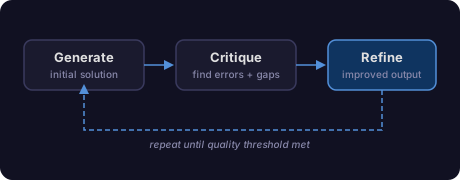
The most impactful pattern is not role-playing, but iteration:
- Generate an initial solution
- Critique or review it
- Refine the result
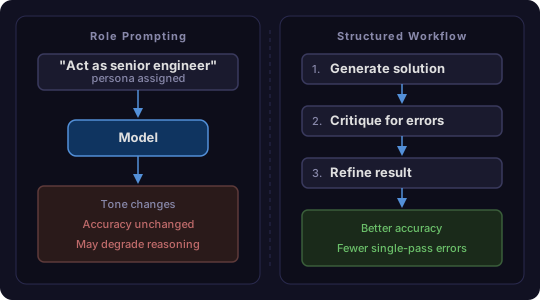
This “generate → critique → refine” loop reliably improves quality by reducing single-pass errors.
Reinterpreting Role-Based Systems Like gstack
Given all this, how should we understand systems built around roles?
The most accurate interpretation is:
Role prompts are not the mechanism—they are the interface.
What these systems actually do is:
- Decompose tasks into stages
- Change objectives between steps
- Encourage self-critique
- Enforce structure
The “CEO,” “engineer,” and “reviewer” personas are simply a convenient way to signal different instructions.
You could remove the roles entirely and replace them with explicit directives:
- “Evaluate business viability”
- “Design system architecture”
- “Critique for correctness and edge cases”
The underlying benefit would remain.
Where Role Prompting Might Still Help
To be fair, there are a few edge cases where roles can be useful:
- When they implicitly encode complex instruction bundles
- When they improve output style for human consumption
- When they help non-expert users structure prompts
But these are secondary effects—not fundamental capability improvements.
Conclusion
The idea that assigning roles fundamentally changes how an LLM solves problems is not strongly supported by current evidence.
A more accurate summary is:
- Role prompts can slightly influence tone and coverage
- They do not reliably improve reasoning ability
- In some cases, they can even hurt performance
Meanwhile, the techniques that do matter are:
- Clear instructions
- Structured outputs
- Iterative workflows
So if systems like gstack appear to work, it’s not because the model is “thinking like a CTO.”
It’s because:
The workflow forces the model to think twice.
References
Kim, J., Yang, N., & Jung, K. (2024). Persona is a Double-edged Sword: Mitigating the Negative Impact of Role-playing Prompts in Zero-shot Reasoning Tasks. arXiv: 2408.08631.
Tan, F.A., Yeo, G.C., Jaidka, K., et al. (2024). PHAnToM: Persona-based Prompting Has An Effect on Theory-of-Mind Reasoning in Large Language Models. arXiv: 2403.02246.
Wei, J., Wang, X., Schuurmans, D., et al. (2022). Chain-of-Thought Prompting Elicits Reasoning in Large Language Models. arXiv: 2201.11903.
Zheng, M., Pei, J., Logeswaran, L., Lee, M., & Jurgens, D. (2024). When “A Helpful Assistant” Is Not Really Helpful: Personas in System Prompts Do Not Improve Performances of Large Language Models. Findings of EMNLP 2024.